
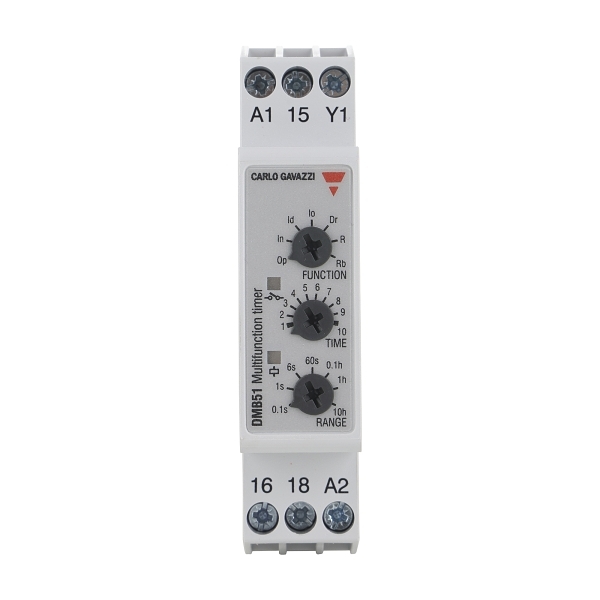
Why Are Timer Relays a Silent Force Behind Efficient Automation?

Timer relays are often overshadowed by more complex automation components, yet they are the silent force behind timed precision in electrical systems. Found in everything from motor controls to lighting systems, these underrated devices automate operations with defined delays, enhancing safety, coordination, and consistency in industrial and domestic setups.
What Makes Timer Relays Different?
Unlike standard relays that instantly switch when energized, timer relays introduce a delay between signal input and action. This delay can either trigger or cut off power after a preset interval, allowing engineers to automate sequences without manual oversight or programming-heavy logic controllers.
Available in both analog and digital variants, timer relays provide timed switching through simple rotary dials or programmable inputs. They’re used for brief delays in milliseconds or for long durations up to hours.
Types of Timer Functions You Should Know
Timer relays are designed with multiple time-based functions tailored to application-specific demands. Some relays offer only one function, while others combine many in a single unit, making them flexible for various control scenarios.
On-delay timers wait before activating output after power is applied. These are commonly used to prevent immediate start-up.
Off-delay timers deactivate output after a set period once the control signal is removed. This is useful in lighting systems or alarms that need to remain active briefly.
Interval timers energize the output for a specific time span immediately after receiving the signal, irrespective of how long the input remains.
Cyclic timers continuously switch between ON and OFF states at intervals, ideal for flashing lights or ventilator systems.
Where Timer Relays Prove Invaluable
Timer relays offer a timing backbone in industrial and residential electrical systems. Their applications are extensive due to their versatility and reliability in time-sensitive processes.
In conveyor systems, timer relays coordinate motor start-up and shutdown intervals to avoid load spikes.
For HVAC equipment, they delay compressor activation to prevent damage from short cycling and enable smoother transitions.
In pump control systems, timer relays automate drainage or water distribution intervals, ensuring precision and reducing energy waste.
Lighting circuits benefit from timed control to switch on or off automatically at specific times or based on delay settings.
Industrial ovens and heaters use timers for controlled heating durations, enhancing safety and process consistency.
Key Parameters That Define a Timer Relay
Every timer relay is defined by several parameters that dictate its suitability for a given application. Understanding these specifications is essential before integration.
Time range is a crucial factor—some relays offer narrow windows like 0.1 to 10 seconds, while others handle minutes or hours.
Control voltage compatibility ensures the relay works within the electrical standards of your system—typically 12V, 24V, or 230V AC/DC.
Output contact type and rating define what load can be switched. Options include SPDT, DPDT, and relay contacts rated for various amperages.
Mounting options, such as DIN rail, flush panel, or socket plug-in, influence how easily the relay can be integrated into an enclosure or cabinet.
Triggering mechanism defines how the timing cycle starts—via power-on, external switch, or signal from another controller.
Evolving With Technology
While the core function remains timeless, timer relay technology has evolved to support modern automation needs. New-generation relays are smaller, smarter, and equipped with advanced features.
Digital timer relays now come with LCD displays, keypad inputs, and menu navigation for more precise setting adjustments.
Multifunction relays allow technicians to select different timing modes within one unit, eliminating the need for multiple products.
Communication-ready models support protocols like Modbus, enabling real-time data exchange with PLCs and SCADA systems.
Energy-efficient designs consume minimal standby power and support green initiatives in building and factory systems.
Timer Relays in Motor Control Systems
An essential use case of timer relays is their role in star-delta motor starting. These systems require a brief delay between the star and delta connections to manage high inrush currents. Timer relays are used here to automate that delay accurately, protecting both the motor and the electrical infrastructure from mechanical and thermal stress.
Why Industries Rely on Timer Relays
Industries continue to depend on timer relays because of their simplicity, cost-effectiveness, and adaptability.
- They simplify automation in applications that don’t require full-blown controllers.
- They reduce human error by standardizing time-based operations.
- They increase uptime by preventing premature activation or power-on surges.
- They minimize maintenance, as most timer relays are durable with a long operational life.
- They lower costs, making them a preferred solution for small systems where budget constraints rule out PLCs.
Final Verdict
Though compact and often overlooked, timer relays are foundational to automation. They eliminate guesswork in timing, support precise control, and improve safety across electrical systems. As industries lean further into automation, the demand for dependable, programmable, and efficient timer relays will only grow.
If your goal is streamlined performance with minimal complexity, a well-chosen timer relay is not just an option—it’s a necessity.
